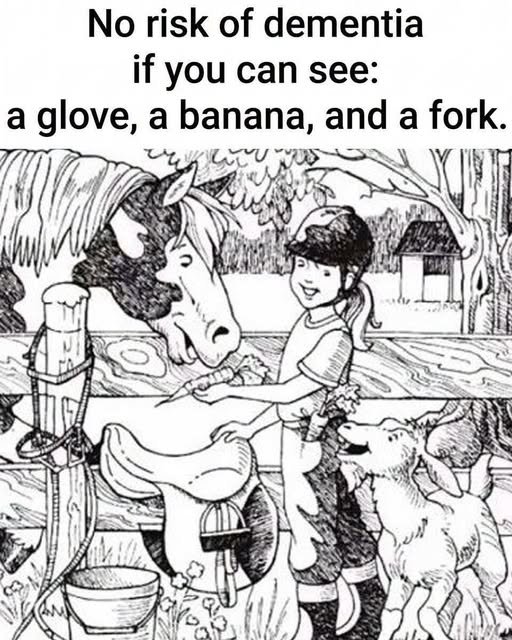
Can You Find the Glove, Banana, and Fork? The Hidden Object Puzzle That Tests Your Observation Skills
A Step-by-Step Method for Solving the Puzzle
If you haven’t found all three objects, try a more systematic approach.
Step 1: Divide the Picture Into Sections
Rather than searching the entire illustration at once, imagine dividing it into four equal areas.
Examine the upper-left section first, followed by the upper-right.
Then move to the lower sections.
This method reduces the likelihood of repeatedly overlooking the same area.
Step 2: Focus on Outlines
Hidden-object illustrations often rely on recognizable shapes being incorporated into unrelated objects.
Follow curved lines and unusual edges.
Ask yourself whether a particular outline could represent something other than its apparent purpose.
Step 3: Look for Unexpected Patterns
A fork’s prongs, a glove’s fingers, or a banana’s curve might be hidden within a larger pattern.
Look for shapes that seem slightly unusual compared with the surrounding details.
Step 4: Change Your Viewing Distance
Sometimes, moving slightly farther away from a picture makes larger shapes easier to recognize.
In other cases, zooming in helps reveal subtle details.
Experiment with both approaches.
Step 5: Take a Short Break
If you feel stuck, stop examining the image for a moment.
When you return, you may notice something that escaped your attention before.
A fresh look can help you move beyond your initial interpretation.
Does Finding the Objects Mean You Have a Lower Risk of Dementia?
Some versions of this visual challenge circulate online with claims suggesting that finding the hidden objects means someone has no risk of dementia.
That claim is not medically supported.
Finding a glove, banana, and fork in an illustration cannot determine whether someone has dementia or predict their future risk of developing the condition.
Dementia is a broad term describing a decline in cognitive abilities severe enough to interfere with everyday functioning.
It can affect memory, reasoning, communication, judgment, and other cognitive skills.
Healthcare professionals evaluate potential cognitive problems using medical history, clinical assessments, and, when appropriate, additional examinations.
A recreational visual puzzle is not a substitute for those evaluations.
Likewise, struggling to identify a hidden object does not indicate that someone has dementia.
People may perform differently because of attention, vision, familiarity with puzzles, fatigue, or many other ordinary factors.
Can Visual Puzzles Be Good for Your Brain?
Visual puzzles can be an enjoyable way to engage attention and practice problem-solving.
They encourage people to examine details, recognize patterns, and explore alternative interpretations.
For many individuals, these activities provide relaxation and entertainment.
They can also create opportunities for social interaction when shared with friends or family.
However, it is important to avoid overstating their medical benefits.
Although cognitively stimulating activities may contribute to an active lifestyle, there is no reliable evidence that completing one hidden-object puzzle prevents dementia.
Brain health is influenced by many factors, including age, genetics, physical health, lifestyle, and medical conditions.
Enjoy puzzles for the challenge rather than treating them as diagnostic tools.
Why People Love Sharing Hidden-Object Challenges
Hidden-object puzzles have remained popular across generations.
They appear in children’s activity books, newspapers, magazines, and online communities.
Part of their appeal comes from their simplicity.
You don’t need special equipment or advanced knowledge to participate.
Anyone can look at an illustration and begin searching.
The challenge also creates a natural conversation.
One person might discover the banana immediately, while another notices the fork first.
Comparing observations can be entertaining because different viewers often focus on different features.
The satisfaction of finally recognizing a hidden shape makes the experience especially memorable.
What Makes This Farm Illustration Interesting?
This particular puzzle combines familiar countryside imagery with unexpected objects.
The peaceful setting creates a natural distraction.
A girl feeding a horse is a scene that viewers can understand almost immediately.
The goat, fence, and trees reinforce the impression that nothing unusual is happening.
But the hidden glove, banana, and fork require a different kind of observation.
Instead of simply understanding the scene, you must analyze its individual components.
That shift from general recognition to detailed inspection is what makes the challenge effective.
Final Thoughts: Did You Find All Three Objects?
The hidden-object puzzle featuring a girl, a horse, and a goat may look simple, but its clever design encourages careful observation.
A glove, banana, and fork are concealed among the familiar shapes of the countryside.
Finding them requires patience, attention, and a willingness to look beyond your first impression.
Whether you discover all three immediately or need several attempts, the purpose is to enjoy the challenge.
Your performance does not measure your intelligence or determine your risk of dementia.
Sometimes, the most interesting part of a puzzle is realizing how much detail we overlook when we think we already understand what we’re seeing.
Now return to the illustration one last time.
Can you spot the glove, the banana, and the fork without using any additional hints?