The Unforgettable White-Haired Boy: A Story About Growing Up Different and Finding Confidence
The Unforgettable White-Haired Boy: A Story About Growing Up Different and Finding Confidence
Some photographs capture people’s attention because of a beautiful landscape, an unusual moment, or an unexpected expression. Others become memorable because of the person standing in front of the camera.
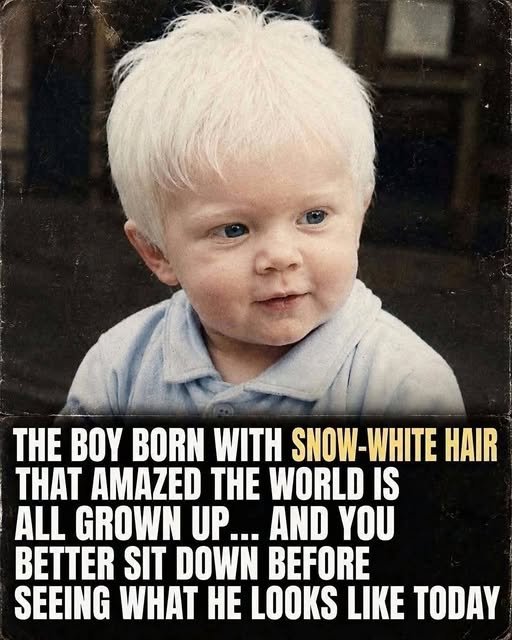
That is the idea behind the widely shared story of a little boy with striking white hair, pale features, and blue eyes.
His appearance attracted curiosity, admiration, and countless questions from strangers. Yet behind the photographs was something far more meaningful than his unusual coloring: a child growing up while other people focused on how different he looked.
The story of the white-haired boy offers an important reminder that every child deserves to be understood as a person, not defined by a physical characteristic.
Although the original account does not provide independently verifiable identifying details, its central message raises valuable questions about genetics, childhood confidence, privacy, and acceptance.
The Appearance That Captured People’s Attention
The boy described in the circulating story had exceptionally light hair from an early age.
Combined with his pale complexion and blue eyes, the coloring created a distinctive appearance that people immediately noticed.
As photographs circulated online, viewers became interested in understanding what made him look different.
Some admired his features, while others wondered whether his appearance might be connected to an underlying genetic condition.
This reaction illustrates how quickly unusual physical traits can attract public attention.
However, a photograph cannot reveal everything about a person’s health, personality, or family circumstances.
The exact cause of the boy’s coloring cannot be established from appearance alone.
Why Can a Child Have Naturally White Hair?
Hair color is influenced primarily by a pigment called melanin.
Specialized cells known as melanocytes produce melanin, which contributes to the coloring of hair, skin, and eyes.
Different types and amounts of melanin create the wide variety of natural human appearances.
When hair contains very little pigment, it may look extremely light blonde, silver, or white.
The Role of Genetics
Genes influence how pigment is produced, distributed, and maintained throughout the body.
Some inherited variations result in naturally lighter coloring without necessarily indicating a medical problem.
Other genetic conditions can significantly affect pigmentation.
One well-known example is albinism, a group of inherited conditions involving reduced or absent melanin production.
Depending on the particular type, albinism can affect the skin, hair, and eyes.
However, white hair does not automatically mean that someone has albinism.
Several genetic and medical factors can influence pigmentation, and an accurate diagnosis requires appropriate professional assessment.
Albinism and the Importance of Accurate Information
Albinism is often misunderstood because public discussions tend to focus almost exclusively on appearance.
In reality, many forms of albinism can also affect vision.
Individuals may experience light sensitivity, reduced visual acuity, or other vision-related difficulties.
The severity varies considerably.
Some people benefit from specialist eye care, visual aids, and appropriate protection against ultraviolet radiation.
Because melanin contributes to the skin’s natural protection against sunlight, certain individuals with albinism also need particular attention to sun safety.
Yet these considerations should never be used to make assumptions about an unfamiliar child in a photograph.
Only the child, family, and qualified healthcare professionals can provide reliable information about an actual medical diagnosis.
Growing Up When Everyone Notices You
Childhood is a time when people gradually develop confidence, friendships, interests, and a sense of identity.
Children naturally notice differences among themselves.
They may ask questions about unusual hair colors, birthmarks, glasses, mobility aids, or other visible characteristics.
Curiosity is not necessarily unkind.
However, repeated attention can become uncomfortable when a child feels that everyone is looking at them for the same reason.
A child with an unusual appearance may enjoy positive comments but still wish to be treated like everyone else.
Constantly being described as exceptional or different can sometimes create pressure, even when the comments are intended as compliments.
The important issue is whether the child feels respected, comfortable, and included.