Why Do Padlocks Have Tiny Holes at the Bottom? The Hidden Purpose Explained
Are All Padlocks Designed With Drainage Holes?
Not every padlock includes visible openings in its base.
Some models rely on different methods to protect their internal components.
Weather-resistant padlocks may feature protective covers, seals, corrosion-resistant materials, or specially designed housings.
Other models are intended primarily for dry indoor environments.
The exact construction depends on the manufacturer’s priorities and the conditions for which the product was designed.
A padlock without visible drainage holes is not automatically inferior.
Similarly, the presence of these openings does not guarantee exceptional durability.
The quality of the materials, internal mechanism, and protective features all influence performance.
How to Maintain a Padlock Properly
Good maintenance can help extend the useful life of many padlocks.
Although maintenance requirements vary, several basic practices are widely applicable.
1. Keep the Exterior Clean
Dirt, mud, and debris can accumulate around the shackle and keyway.
Remove visible dirt with a soft cloth or brush suitable for the lock’s finish.
Avoid forcing debris deeper into the mechanism.
2. Inspect for Corrosion
Check the shackle and exposed metal surfaces periodically.
Discoloration, rough movement, or visible deterioration may indicate that the lock needs attention.
If corrosion is severe or the mechanism becomes unreliable, replacement may be the safest option.
3. Use Manufacturer-Approved Lubricants
Apply the recommended lubricant only where instructed.
Using excessive amounts or unsuitable products can cause additional problems rather than solve them.
4. Avoid Forcing a Stuck Key
If the key becomes difficult to turn, excessive force may bend or break it.
Check for obvious damage or contamination and seek professional assistance if the lock remains stuck.
5. Choose the Right Lock for the Environment
A padlock intended for a dry locker may not withstand years of outdoor exposure.
Choose products designed for the conditions in which they will be used.
What Happens When Water Gets Trapped Inside?
The effects of trapped moisture may develop gradually.
Initially, the padlock may continue functioning without noticeable problems.
As internal corrosion develops, movement can become less smooth.
Users may begin experiencing resistance when turning the key or closing the shackle.
In colder weather, moisture inside certain locks can freeze, temporarily preventing operation.
Repeated exposure to freezing and thawing conditions may contribute to additional wear.
However, a difficult-to-open lock does not always indicate water damage.
Misalignment, dirt, worn components, and mechanical defects can produce similar symptoms.
If a lock is used to secure valuable property, persistent operating problems should not be ignored.
Can You Make an Ordinary Padlock Waterproof?
It is important to distinguish between water resistance and waterproofing.
A weather-resistant padlock is designed to tolerate certain environmental conditions.
A waterproof rating, when provided, refers to specific protection characteristics established by the manufacturer or applicable testing standards.
Adding lubricant or covering a lock with household materials does not necessarily make it waterproof.
In fact, blocking an existing drainage opening may trap moisture and interfere with the original design.
Drilling additional holes is also not recommended.
Doing so could damage internal components, reduce security, or compromise protective features.
For locations exposed to frequent rain or moisture, purchasing a suitable outdoor-rated padlock is generally more reliable than attempting to modify an indoor model.
Small Design Features That Make Everyday Objects Better
The tiny openings found on some padlocks illustrate a broader principle of product engineering.
Useful design details are not always immediately obvious.
Many household items contain small features intended to solve specific practical problems.
Drainage channels, ventilation openings, protective seals, and maintenance access points may seem insignificant until their purpose becomes clear.
In the case of padlocks, a carefully positioned opening can help reduce moisture accumulation or provide access for maintenance.
These features demonstrate how manufacturers balance durability, convenience, cost, and mechanical performance.
Final Thoughts: A Small Hole With an Important Job
The next time you examine a padlock, take a moment to look at its underside.
Those tiny openings may be more important than they first appear.
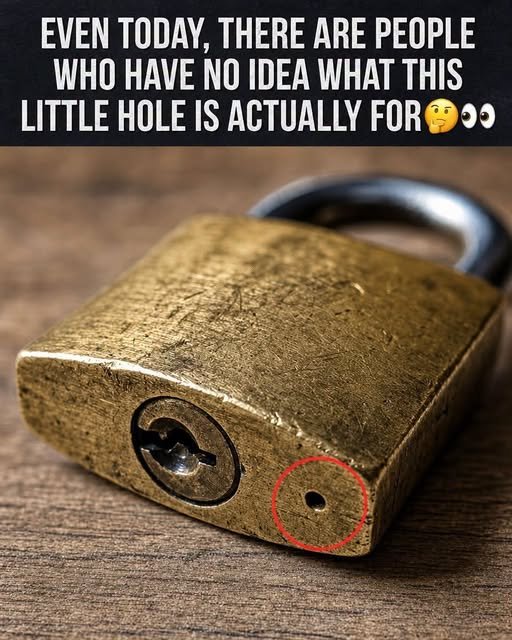
On many models, they allow accumulated moisture to drain away, helping reduce the risk of corrosion and mechanical difficulties.
On certain designs, an opening may also provide access for appropriate lubrication.
However, the precise purpose varies between products, so manufacturer instructions remain the most reliable guide.
The real lesson is that small engineering details can contribute to the durability and reliability of everyday objects.
A padlock may look like a simple metal accessory, but its effectiveness depends on the careful interaction of materials, moving parts, and protective features.
And sometimes, one of its most useful features is something small enough to go almost completely unnoticed.