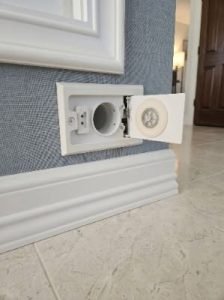
What Is This Strange Electrical Outlet Near the Floor? The Surprising Explanation
6. What Makes a Central Vacuum System Different From a Regular Vacuum?
The biggest difference is where the main machine is located.
A conventional vacuum cleaner brings its motor and dust collection system into the room being cleaned.
A central vacuum system usually keeps those components in a separate location.
This can create several practical advantages.
For example, the cleaning hose may be lighter to maneuver than a complete upright vacuum.
The main motor can also be located away from living areas, potentially reducing the noise experienced inside the room.
Some installations discharge filtered exhaust air outside the living space, although this depends on the model and setup.
However, central vacuum systems aren’t automatically better for every household.
Their performance and convenience depend on the equipment, installation quality, maintenance, and individual cleaning needs.
7. The Hidden Pipes Inside the Walls
One of the most fascinating parts of a central vacuum system is that most of it remains invisible.
Behind the walls, a network of pipes connects individual vacuum inlets to the central motor.
When the system operates, air flows through these pipes, carrying dust and debris toward the collection container.
The pipe layout must be carefully planned to maintain airflow and reduce the risk of clogs.
Sharp turns, poor connections, or damaged tubing can affect performance.
Professional installation is especially important because the system may involve both electrical wiring and concealed pipework.
This hidden infrastructure explains why a small opening in the wall can be connected to a much larger cleaning system.
8. What Happens to All the Dust?
The dust doesn’t disappear into the walls.
It travels to a central collection unit.
Depending on the model, this unit may use a collection bag, a removable canister, filters, or a combination of components.
The homeowner periodically empties or replaces the collection container.
How often this is necessary depends on the size of the container, how frequently the system is used, and the amount of debris collected.
Like any vacuum cleaner, central systems also require occasional maintenance.
Filters may need cleaning or replacement, hoses can become obstructed, and motors may eventually require servicing.
9. Are Central Vacuum Systems Expensive?
Installing a central vacuum system generally requires a greater initial investment than purchasing a basic portable vacuum cleaner.
Costs depend on the size of the property, the number of inlets, the equipment selected, and whether the home is under construction or already finished.
Installing tubing during new construction may be simpler than retrofitting a completed house.
Existing homes may require additional work to route pipes through walls, ceilings, or other spaces.
Homeowners should obtain a detailed estimate from a qualified installer before deciding whether the investment makes sense.
A central vacuum system can provide convenience, but it’s not a necessity for maintaining a clean home.
10. Can You Use an Old Central Vacuum Outlet?
Suppose you discover an inlet like the one in the photograph.
Before trying to use it, you should determine whether a complete central vacuum system is still installed.
Start by checking the property’s documentation or asking the previous owner.
Look for a central vacuum collection unit in the garage, basement, or utility room.
You may also find several similar wall inlets throughout the house.
If the equipment is present but hasn’t been used for years, professional inspection is a sensible precaution.
The system may have disconnected tubing, deteriorated seals, damaged wiring, or other faults.
Never insert fingers, metal objects, or improvised equipment into an unfamiliar outlet.
And don’t assume that a hose will fit safely just because the opening looks compatible.
11. Could the Fixture Be Something Else?
Yes, and this is an important detail.
Although the round opening resembles a central vacuum inlet, photographs alone cannot always identify unusual wall fixtures with certainty.
Some wall installations combine electrical sockets with ventilation openings, utility connections, or other specialized equipment.
The grille visible in the hinged cover is also unusual enough that the specific fixture should be verified.
A central vacuum connection remains a plausible explanation, particularly because of the circular port and nearby electrical outlet.
But the exact purpose would need confirmation through the device’s manufacturer, any identifying markings, or an inspection of what the opening connects to.
This is especially important when electricity is involved.
12. Why Do So Many People Find These Fixtures Mysterious?
Home technology changes quickly.
Features that were once familiar can become difficult to recognize when newer alternatives take their place.
Think about old telephone jacks, cable television connections, intercom systems, and built-in speaker outlets.
A homeowner might move into an older property and discover several wall fixtures that no longer serve an obvious purpose.
Without the original equipment, their function can be surprisingly difficult to identify.
Central vacuum inlets can create the same confusion.
A small door near the floor might look completely ordinary to someone who grew up with a built-in vacuum system.
But to someone who has only used cordless or upright cleaners, it may seem like a strange electrical invention.
13. Should You Install a Central Vacuum System in Your Home?
That depends on your priorities.
A central vacuum system may appeal to homeowners who want to keep the main vacuum motor and collection unit outside their living areas.
It may also be useful in larger homes where multiple wall inlets can provide convenient access.
On the other hand, modern cordless vacuum cleaners offer portability without the need for permanent pipework.
Robotic cleaners can handle some routine maintenance tasks automatically.
Each option has advantages and limitations.
Before investing in a central vacuum system, consider installation expenses, available storage space, cleaning requirements, and long-term maintenance.
The best solution is the one that fits your household.
Final Thoughts: A Small Opening With a Clever Purpose
At first glance, the unusual fixture in the photograph looks like a mysterious electrical outlet.
But its circular opening and nearby socket suggest a much more interesting possibility: a built-in central vacuum cleaning connection.
Such systems allow homeowners to attach a hose to the wall while a separate motor provides suction through hidden pipes.
It’s a clever example of home technology designed to make everyday chores easier.
Although the exact fixture pictured would need closer inspection for a definitive identification, the photograph offers a fascinating glimpse into a type of household equipment many people have never encountered.
Sometimes, the strangest-looking features in a house have surprisingly practical purposes.
Have You Ever Seen One of These Before?
Did you immediately recognize this unusual wall fixture, or did you think it was something completely different?
Perhaps you grew up in a house with a central vacuum system, or maybe you’ve discovered a mysterious outlet in your own home.
Would you rather use a built-in central vacuum system or a modern cordless vacuum cleaner?
Share your experience in the comments. Your answer might help someone else understand an unusual feature they’ve noticed in their home.