What Is This Strange Electrical Outlet Near the Floor? The Surprising Explanation
What Is This Strange Electrical Outlet Near the Floor? The Surprising Explanation
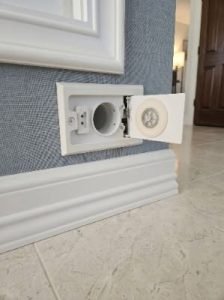
Imagine moving into a new house and discovering something unusual near the baseboard. At first glance, it looks like an electrical outlet, but when you open the little door, you find a large circular opening beside a regular-looking socket.
What could it possibly be?
Is it an old electrical installation? A hidden ventilation system? Or perhaps a forgotten feature from another era?
The answer may surprise you.
This unusual wall fixture looks like a connection point for a built-in central vacuum cleaning system.
It’s a clever home feature that allows people to clean their floors without carrying a traditional vacuum cleaner from room to room.
And while many homeowners have never encountered one, central vacuum systems have been installed in residential properties for decades.
1. What Exactly Are We Looking At?
The photograph shows a white rectangular wall fixture installed close to the floor.
Inside the open cover, there are two noticeable features: a circular opening and an electrical socket.
The circular opening resembles the type used to connect a vacuum hose to a central vacuum system.
The nearby socket could provide electricity for a powered vacuum attachment, depending on the installation.
In a typical central vacuum system, the wall inlet connects to tubing hidden inside the walls.
That tubing leads to a powerful vacuum motor and collection container located elsewhere in the building.
Instead of moving a complete vacuum cleaner around the house, the homeowner attaches a hose to the wall.
The system then provides suction through the hose.
It’s a surprisingly convenient idea.
However, the exact purpose and manufacturer of the pictured fixture cannot be confirmed from the photograph alone.
2. How Does a Central Vacuum System Work?
A central vacuum system operates differently from a conventional portable vacuum cleaner.
With an ordinary vacuum, the motor, dust container, filters, and cleaning hose are usually housed in a single machine.
You move the machine around as you clean.
A central vacuum system separates those components.
The main motor and dust collection unit are permanently installed in a location such as a garage, basement, or utility room.
Special tubing runs through the walls to several vacuum connection points throughout the home.
When you connect a compatible hose to one of these inlets, the system can activate and begin removing dust and debris.
The material travels through the tubing and into the central collection container.
Manufacturers such as <Link url=”https://www.thinkvacuums.com/central-vacuums/signature/wall-inlets” title=”ThinkVacuums”/> explain how these wall inlets connect cleaning hoses to a central suction network.
3. Why Is There an Electrical Socket Next to the Opening?
This is probably the most confusing part of the photograph.
Why would a vacuum connection need an electrical socket?
The explanation involves powered cleaning attachments.
Some vacuum hoses include electrically powered brush heads designed to improve cleaning performance on carpets and rugs.
These accessories require electricity to operate their rotating brushes.
In certain central vacuum installations, a regular electrical outlet is positioned near the suction inlet so a powered hose or attachment can receive electricity.
Other systems use specialized electrified inlets that combine electrical connections with the vacuum-hose connection.
The precise arrangement depends on the system’s design.
That’s why the socket shown in the photograph shouldn’t automatically be assumed to be part of the vacuum system’s internal electrical circuitry.
A qualified professional can identify its actual function.
4. Why Are These Outlets Installed So Close to the Floor?
The location is practical.
Central vacuum inlets are often installed in hallways, living rooms, and other accessible areas where a hose can reach multiple spaces.
Positioning an inlet low on the wall may make it convenient to connect a cleaning hose.
It can also help keep the fixture relatively discreet.
However, not all central vacuum inlets are installed near the floor.
Some are mounted at approximately the same height as ordinary electrical outlets.
Others are integrated into baseboards or kitchen cabinets.
The best location depends on the home’s layout, the hose length, accessibility, and the installation design.
5. Are These Systems Still Used Today?
Yes.
Although cordless and robotic vacuum cleaners have become increasingly popular, central vacuum systems remain available.
Some homeowners appreciate having a powerful cleaning unit permanently installed rather than carrying a machine between rooms.
Central vacuum installations can be found in older homes as well as newer custom-built properties.
For people who discover an unfamiliar vacuum inlet after purchasing a house, it may be a sign that the property once had a central cleaning system.
But finding the wall inlet doesn’t guarantee that the system is complete or operational.
The central motor, tubing, and electrical connections may need inspection.