What Does the “O” in “O’Clock” Actually Stand For? The Surprising History Behind a Word We Use Every Day
5. Why Is There an Apostrophe in “O’Clock”?
The apostrophe isn’t simply decorative.
It’s a reminder that the word developed from a longer expression.
In English, apostrophes often mark missing letters in contractions.
For example, “it’s” represents “it is” or “it has,” depending on context.
Similarly, the apostrophe in “o’clock” reflects the shortening of “of the clock.”
What makes this expression interesting is that many people no longer recognize it as a contraction.
Unlike “don’t” or “isn’t,” which clearly resemble their original forms, “o’clock” has become an independent expression in everyday English.
Most speakers learn it as a complete word rather than a shortened phrase.
And that’s one reason its origin can be such a surprise.
6. When Did People Start Using “O’Clock”?
The history of the expression reaches back to medieval English.
Historical records contain forms such as “of the clokke” and “of clok,” reflecting differences in spelling and pronunciation over time.
These early forms show how the expression developed before reaching its modern spelling.
The exact dates given for particular versions can vary depending on which historical documents and spelling forms are being examined.
What is clear is that the language evolved gradually.
People didn’t gather one morning and officially decide to replace “of the clock” with “o’clock.”
Instead, generations of speakers naturally adapted the phrase through repeated everyday use.
This is one of the most fascinating aspects of language history: many expressions become standard simply because people find them convenient.
7. Why Do We Say “Five O’Clock” but Not “Five Thirty O’Clock”?
Here’s another interesting detail.
In modern standard English, “o’clock” is generally used when referring to an exact hour.
For example:
“It’s four o’clock.”
“The meeting starts at nine o’clock.”
“We arrived at twelve o’clock.”
But when the time includes minutes, we usually express it differently.
We say “four thirty,” “ten fifteen,” or “a quarter past seven.”
We normally wouldn’t say “four thirty o’clock.”
That’s because the modern expression has become closely associated with whole hours.
It’s simply part of the grammatical convention English speakers have developed over time.
Of course, we can also say “four in the afternoon” or “nine in the evening” when additional context is useful.
8. Does “O’Clock” Have Anything to Do With Zero?
Some people assume the “O” might represent the number zero.
After all, the letter O and the number 0 look remarkably similar.
But that isn’t where the expression comes from.
The “O” is connected to the older phrase “of the clock,” not the digit zero.
This confusion is understandable because modern timekeeping often involves numbers, particularly when reading digital clocks.
For example, 7:00 contains two zeros.
However, those zeros and the letter in “o’clock” have completely different origins.
The similarity is visual rather than historical.
9. Why Do We Still Use Such an Old Expression?
English contains countless words and phrases that have survived long after their original contexts changed.
Consider expressions such as “hang up the phone.”
People originally hung telephone receivers on physical hooks or cradles.
Today, we still say “hang up” even when ending a call on a touchscreen.
Similarly, “dial a number” remains familiar despite the disappearance of rotary dials from most modern homes.
“O’clock” is another example of linguistic history surviving in everyday conversation.
We no longer need to distinguish mechanical clocks from older methods of telling time in the same way people once did.
Yet the phrase remains useful, familiar, and universally understood among English speakers.
Language doesn’t always discard an expression just because technology changes.
Sometimes, it preserves a little piece of history.
10. Other Everyday Expressions With Surprising Origins
Once you start examining ordinary words, you discover that many carry unexpected stories.
Goodbye
The word “goodbye” developed from the older expression “God be with ye.”
Over time, pronunciation and spelling changed until it became the farewell we recognize today.
Breakfast
The word “breakfast” comes from the idea of breaking a fast.
After spending the night without eating, the first meal of the day ends that period of fasting.
Deadline
The word “deadline” has a much darker history than its modern meaning of a time limit.
It was historically used in contexts involving literal boundaries, including prison camps, before developing its familiar figurative sense.
Clock
Even the word “clock” has an interesting background.
Its history is associated with words meaning “bell,” reflecting the importance of bells in early mechanical timekeeping.
These examples demonstrate how ordinary language can preserve traces of older customs, technologies, and beliefs.
11. Why Learning Word Origins Is So Fascinating
Understanding the origins of familiar expressions changes the way we experience language.
A word that once seemed completely ordinary suddenly becomes a connection to the past.
We begin to recognize that the language we speak today is the result of countless generations adapting, borrowing, shortening, and transforming expressions.
Some words disappear entirely.
Others change meaning.
And certain expressions survive for centuries with only minor alterations.
“O’clock” belongs to that last category.
It has remained useful even as the technology used to measure time has changed dramatically.
From public clocks and church bells to wristwatches and smartphones, the expression continues to connect modern speech with earlier centuries.
12. A Small Word With Hundreds of Years of History
The next time someone asks you what time it is, listen carefully to your answer.
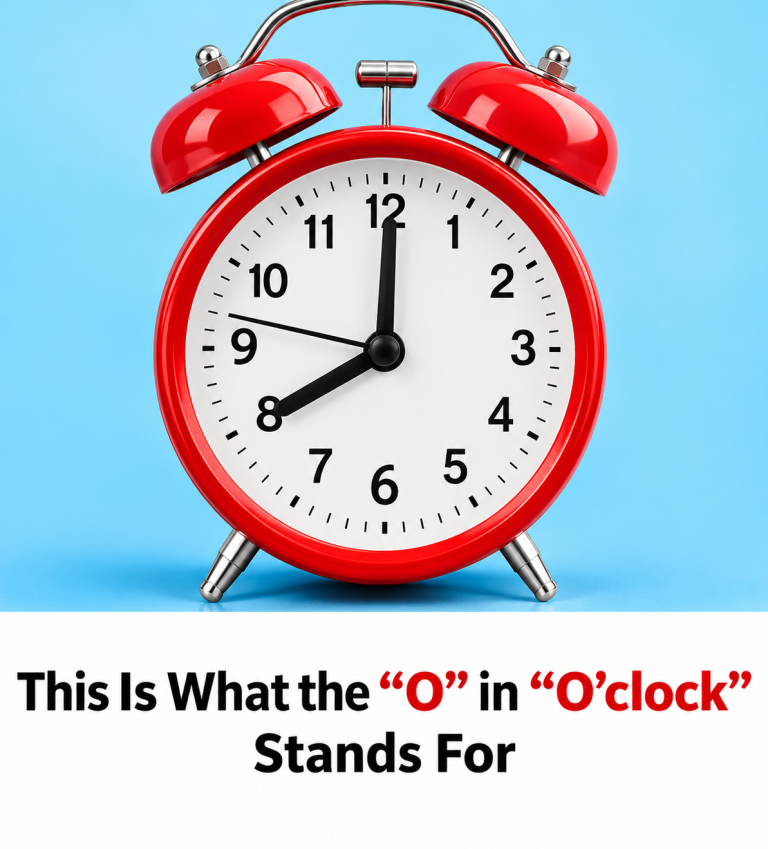
If you say “eight o’clock,” you’re using a phrase whose roots stretch back to a very different world.
A world without smartphones, digital alarms, or constantly synchronized electronic clocks.
A world where mechanical timekeeping was still developing and people gradually adopted new ways of describing the hours.
And all that history is hidden inside a tiny letter and an apostrophe.
That’s what makes the story so memorable.
Final Thoughts: Now You Know What the “O” Really Means
The mystery has a wonderfully straightforward answer.
The “O” in “o’clock” comes from “of,” and the expression developed from the older phrase “of the clock.”
What sounds like an ordinary word today is actually a reminder of how English has changed over hundreds of years.
It’s remarkable that something we say several times a day can carry such a long history.
And it makes you wonder how many other familiar expressions have stories we’ve never discovered.
Did You Already Know This? ⏰
Be honest: Did you know that “o’clock” originally meant “of the clock,” or did you just learn something new today?
Share your answer in the comments, and tell us another everyday word whose meaning or origin surprised you!