What Does the “O” in “O’Clock” Actually Stand For? The Surprising History Behind a Word We Use Every Day
What Does the “O” in “O’Clock” Actually Stand For? The Surprising History Behind a Word We Use Every Day
We say it almost without thinking.
“It’s seven o’clock.”
“Meet me at three o’clock.”
“I can’t believe it’s already midnight!”
But have you ever stopped to wonder what the little letter “O” in “o’clock” actually means?
It’s one of those everyday expressions that almost everyone understands but very few people take the time to question.
The answer is surprisingly simple, yet its history stretches back hundreds of years.
And once you understand where the expression comes from, you’ll probably never look at a clock quite the same way again.
1. The Real Meaning of the “O” in “O’Clock”
Here’s the answer that surprises many people:
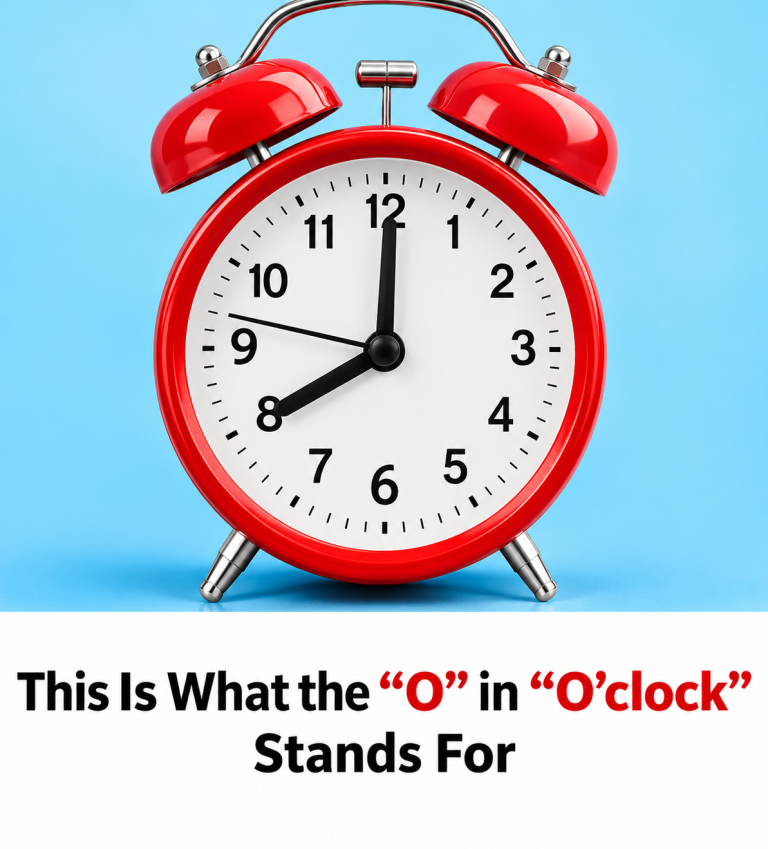
The “O” in “o’clock” comes from the word “of.”
The expression is a shortened version of the older English phrase “of the clock.”
So when someone says “five o’clock,” they’re using a modern form of what was once expressed as “five of the clock.”
The phrase essentially meant that the time was five according to the clock.
Over the centuries, English speakers shortened the expression, eventually producing the familiar word we use today.
According to <Link url=”https://scrabble.m-w.com/wordplay/the-origin-of-oclock” title=”Merriam-Webster’s explanation of the origin of o’clock”/>, the history of the expression is closely connected to the introduction and growing use of clocks in English-speaking society.
It’s a wonderful example of how language changes naturally through everyday conversation.
2. Why Did People Say “Of the Clock”?
To understand the expression, we need to travel back to a time when knowing the exact hour wasn’t nearly as simple as checking a smartphone.
For much of human history, people relied on the position of the sun, the changing seasons, and other natural signals to organize their daily routines.
Farmers worked according to daylight.
Communities observed religious schedules.
Travelers estimated time using the sun and their surroundings.
Although various timekeeping devices had existed for centuries, mechanical clocks gradually became increasingly important in medieval Europe.
As clocks became more common, people developed ways of referring to the hours they displayed.
The expression “of the clock” was one such way of specifying time.
It helped connect a particular hour with the time shown by a clock rather than simply a general period of the day.
3. How “Of the Clock” Became “O’Clock”
English has a long history of shortening expressions that people use frequently.
Think about words such as:
- “Do not” becoming “don’t.”
- “Cannot” becoming “can’t.”
- “It is” becoming “it’s.”
- “I am” becoming “I’m.”
The same basic process helped create “o’clock.”
The longer phrase gradually became shorter in spoken English.
Instead of saying “six of the clock,” speakers could say “six o’clock.”
The apostrophe indicates that part of the original expression has been omitted.
According to historical linguistic references, forms of the expression existed in Middle English, with contracted variations appearing in later centuries.
The <Link url=”https://www.etymonline.com/word/o%27clock” title=”Online Etymology Dictionary”/> traces the expression to older English forms and the development of modern timekeeping vocabulary.
Today, the original phrase sounds old-fashioned, while the shortened version feels perfectly natural.
4. The Fascinating History of Clocks
Before mechanical clocks became widespread, people used several inventive methods to measure time.
Sundials
Sundials were among the earliest timekeeping technologies.
They used the movement of the sun’s shadow to indicate the approximate time of day.
Their biggest limitation was obvious: they depended on sunlight.
Cloudy weather and nighttime made them less useful.
Water Clocks
Water clocks measured time through the controlled movement of water.
Different versions were developed in ancient civilizations, including Egypt, Greece, and China.
Unlike sundials, certain water clocks could operate without sunlight.
Mechanical Clocks
Mechanical clocks emerged in medieval Europe and gradually changed the way communities organized their activities.
Early public clocks often relied heavily on bells to announce the hours.
Over time, improvements in clockmaking made timekeeping more accessible and increasingly precise.
Eventually, domestic clocks and personal watches became familiar parts of everyday life.
Today, we carry highly accurate clocks in our pockets without giving much thought to the centuries of innovation behind them.