No One Had Ever Explained That to Me! The Surprising Reason Some Outlets Are Installed Upside Down (And Why It’s Actually Brilliant)
No One Had Ever Explained That to Me! The Surprising Reason Some Outlets Are Installed Upside Down (And Why It’s Actually Brilliant)
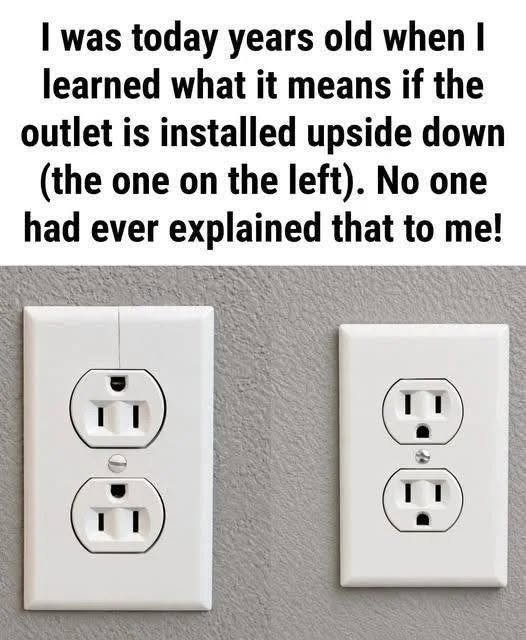
Have you ever noticed an electrical outlet installed with the ground hole facing up instead of down? At first, it might look like a mistake or an unusual design choice. However, there are practical reasons why some electricians install outlets this way. From improving safety in certain situations to following specific electrical requirements, this small detail can have more meaning than you might expect.
Step 1 — Understand Why Some Outlets Are Installed Upside Down
In many homes, electrical outlets are installed with the two vertical slots facing upward and the ground opening below them. But in some buildings, you may find the opposite arrangement.
One common reason is safety.
When an outlet is installed with the ground opening at the top, the grounding pin of a three-prong plug enters first. If a plug begins to come loose, the ground pin may be the last part to disconnect.
This arrangement can reduce the risk of certain electrical hazards in situations where a partially disconnected plug or a loose metal object is involved.
However, it is important to understand that installing an outlet upside down does not automatically make it safer in every situation.
Step 2 — Learn How the Ground Pin Can Help
The third prong on a standard grounded plug is called the ground pin. Its purpose is to provide a safe path for electrical current if a fault occurs in an appliance.
Here is why its position can matter:
- When the ground pin is at the top, it may remain connected longer as a plug starts to fall out.
- If a metal object falls behind a partially disconnected plug, the arrangement may help reduce the chance of creating a short circuit between the live and neutral contacts.
- It can provide an additional safety consideration in certain installations.
Common mistake to avoid: Never assume that an upside-down outlet is incorrectly wired or that every outlet installed this way is safer. The orientation alone does not tell you whether an outlet is properly installed.
Step 3 — Understand Why Electricians Use Different Orientations
There is no single universal orientation used for every electrical outlet.
Electricians may choose an orientation based on local electrical codes, installation practices, and the type of electrical equipment being connected.
For example:
- Some electricians install outlets with the ground opening facing upward for safety-related reasons.
- Others follow the traditional ground-down arrangement.
- In commercial buildings, different orientations may help identify outlets connected to specific circuits.
- Some installations use different arrangements depending on the equipment and workplace requirements.
The important point is that the outlet should be correctly wired, securely mounted, and compliant with local electrical regulations.