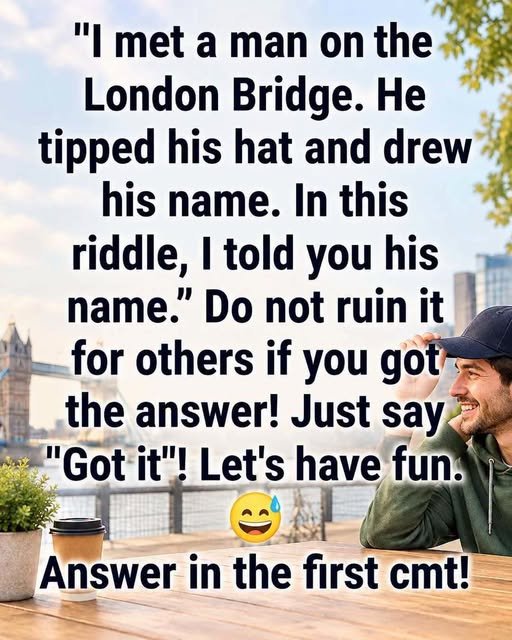
“I Met a Man on London Bridge”: Can You Solve This Clever Riddle?
The Answer: The Man’s Name Is Andrew
The solution is Andrew.
The name is hidden in the phrase:
“and drew” → “Andrew.”
When spoken naturally, the two words can sound very similar to the name Andrew.
That is the entire trick.
The riddle doesn’t need to mention the name directly because it is concealed within an ordinary sentence.
The stranger’s action provides the wordplay, while the question encourages readers to search for a traditional name.
Once you recognize the pronunciation, the answer becomes easy to understand.
The cleverness lies in how naturally the clue fits into the story.
Why London Bridge Is Mentioned
A common question is whether London Bridge has any special significance.
After all, it is one of the most recognizable bridge names in the world.
London Bridge crosses the River Thames in central London, connecting the City of London with Southwark.
The location has a long history, and several different bridges have occupied the crossing over the centuries.
However, none of that historical background is necessary to solve the riddle.
London Bridge simply provides an interesting setting.
Its familiarity makes the story sound believable while directing attention away from the hidden name.
This is a common technique in riddles.
An unnecessary but memorable detail can distract readers from the information that actually matters.
The Difference Between Reading and Hearing the Riddle
Try reading the sentence silently:
“He tipped his hat and drew his name.”
Now say it aloud at a natural conversational pace.
The pronunciation changes how the words are perceived.
In written form, “and” and “drew” appear as separate words with distinct meanings.
In spoken language, their sounds can flow together.
That makes the hidden name easier to recognize.
Linguists sometimes discuss similar phenomena in connection with word boundaries and speech segmentation.
When listening to someone speak, our brains must identify where one word ends and another begins.
Because spoken language is continuous, those boundaries are not always perfectly obvious.
Riddles like this exploit that ambiguity in a playful way.
Three More Riddles That Use Clever Thinking
If you enjoyed the London Bridge puzzle, here are three other classic brain teasers.
1. What Has Keys but Cannot Open Locks?
At first, you might imagine a strange collection of keys.
But the answer is a piano.
A piano has musical keys, yet those keys are not designed to open doors.
The trick depends on recognizing that one word can have several meanings.
2. What Gets Wetter the More It Dries?
This question sounds contradictory.
How can something become wetter while drying another object?
The answer is a towel.
As a towel absorbs moisture from your body or another surface, it becomes increasingly wet.
The riddle works because the word “dries” refers to what the towel does, not what happens to the towel itself.
3. What Has a Face and Two Hands but No Arms or Legs?
The answer is a clock.
Clocks have faces and hands, but these words refer to parts of a timekeeping device rather than parts of a human body.
Again, the puzzle relies on familiar language being interpreted in an unexpected way.
Can Solving Riddles Improve Your Thinking?
Riddles encourage people to examine information from different perspectives.
They may involve attention, vocabulary, memory, reasoning, or creative interpretation.
For example, solving the London Bridge riddle requires moving away from the literal meaning of the sentence and considering how its words sound.
That kind of mental flexibility can be enjoyable to practice.
However, solving riddles should not be presented as a guaranteed way to increase intelligence or prevent cognitive decline.
Their most reliable benefits are entertainment, curiosity, and the opportunity to engage with language and ideas.
They can also provide a fun activity for families, friends, and classrooms.
How to Challenge Your Friends With This Riddle
The best way to share this puzzle is to read it aloud without emphasizing the hidden clue.
Use a natural speaking pace and avoid drawing attention to the words “and drew.”
Ask your listeners to identify the man’s name.
Some may begin guessing common English names.
Others might ask whether the bridge has historical importance.
If nobody recognizes the answer, offer a small hint:
“The name is hidden in how the sentence sounds.”
That clue is usually enough to encourage a different approach.
Once someone discovers Andrew, the group can discuss how the wording created the confusion.
Final Thoughts: The Answer Was There All Along
The “I Met a Man on London Bridge” riddle demonstrates how an ordinary sentence can contain a surprisingly clever linguistic trick.
Its solution doesn’t depend on complicated knowledge, mathematics, or historical facts.
Instead, it asks you to listen carefully.
The words “and drew” conceal the name Andrew, transforming a simple statement into an entertaining puzzle.
Sometimes, solving a riddle isn’t about thinking harder. It’s about looking at familiar information in a different way.
And that is what makes this particular brain teaser so memorable.
Now that you know the answer, try sharing it with someone who hasn’t heard it before.
You may discover that the simplest riddles produce the most entertaining reactions.