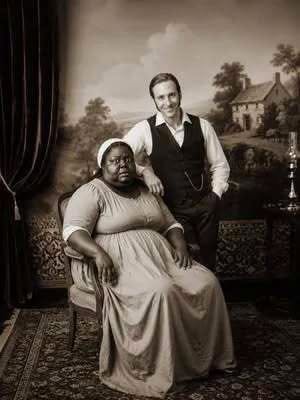
Benedita, the Fighter From Vassouras: The Powerful Story Behind a Forgotten Chapter of Brazilian History
Benedita, the Fighter From Vassouras: The Powerful Story Behind a Forgotten Chapter of Brazilian History
In the heart of Brazil’s coffee-growing region, a remarkable story has captured attention online. It tells of an enslaved woman named Benedita, whose unusual height, physical strength, and refusal to fit society’s expectations supposedly made her an unwanted figure at a nineteenth-century auction.
According to the circulating account, the events took place in 1857 in Vassouras, a Brazilian town deeply connected to the country’s coffee industry.
The story describes a woman who stood nearly two meters tall and was repeatedly rejected by prospective buyers. Eventually, a farmer named Joaquim Lacerda reportedly made an offer that changed the direction of her life.
It is a dramatic narrative about human dignity, prejudice, and survival.
However, an important distinction must be made: although slavery in nineteenth-century Vassouras is extensively documented, the specific story of Benedita and Joaquim Lacerda has not been independently verified through reliable historical records.
That uncertainty does not make the history surrounding the story any less important.
The Story of Benedita That Captured Attention
The widely shared narrative begins at a public auction in Vassouras in 1857.
Benedita is described as an exceptionally tall and physically powerful woman who had reportedly experienced rejection and mistreatment.
According to the account, people gathered around the auction platform, examining those being offered for sale.
The narrative emphasizes how Benedita’s appearance supposedly attracted attention for the wrong reasons.
Rather than recognizing her humanity, prospective buyers reportedly judged her physical characteristics and questioned whether she could be controlled.
The story claims that several buyers refused to make an offer.
Eventually, a farmer identified as Joaquim Lacerda supposedly purchased her for a very small amount.
The narrative presents this moment as a turning point.
Yet the accessible account does not establish what happened afterward, and no verified primary documentation has been identified confirming the alleged transaction.
For that reason, the story is best understood as an unverified historical narrative set against a real and deeply troubling period of Brazilian history.
Vassouras in 1857: A Town Built Around Coffee
To understand the setting, we need to examine the historical importance of Vassouras.
Located in the state of Rio de Janeiro, Vassouras became one of Brazil’s significant coffee-producing communities during the nineteenth century.
The surrounding Paraíba Valley developed extensive plantations that supplied coffee to international markets.
Coffee production generated considerable wealth for plantation owners and merchants.
However, much of that prosperity depended on the forced labor of enslaved African and Afro-Brazilian people.
Enslaved workers cultivated coffee plants, harvested beans, transported agricultural products, and performed demanding domestic and industrial tasks.
Their labor contributed enormously to the region’s economic development, while the benefits were distributed unequally.
The Human Cost of Coffee Production
Plantation life was frequently characterized by exhausting work, restrictions on personal freedom, and the threat of punishment.
Enslaved individuals could be separated from relatives through sale or relocation.
Their daily lives were controlled by systems that denied them fundamental rights.
Historical studies of Vassouras have documented the relationships between plantation ownership, labor exploitation, social inequality, and the development of the regional economy.
These findings provide the factual historical background against which stories such as Benedita’s are often told.
Why Physical Appearance Mattered in Slave Markets
Under slavery, people were legally treated as property, and their perceived economic value could be influenced by several factors.
Age, physical condition, occupation, and perceived ability to perform particular tasks could affect how slaveholders evaluated them.
This practice reflected the profound dehumanization at the center of the system.
People were reduced to financial calculations rather than recognized as individuals with families, emotions, aspirations, and rights.
In the circulating story, Benedita’s extraordinary height supposedly became a reason for rejection.
While the specific incident remains unverified, the broader history of people being evaluated and sold within Brazil’s slave economy is firmly documented.
The narrative therefore raises important questions about prejudice, exploitation, and the ways oppressive systems attempted to define human worth.