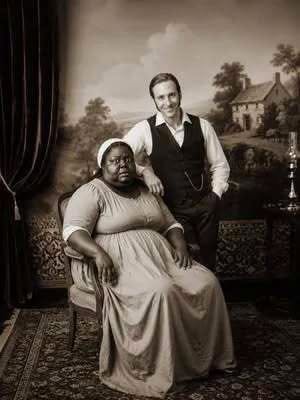
Benedita, the Fighter From Vassouras: The Powerful Story Behind a Forgotten Chapter of Brazilian History
Women and the Reality of Enslavement in Brazil
Women played essential roles in Brazil’s nineteenth-century slave economy.
They worked in agriculture, household service, food preparation, textile production, and numerous other activities.
Their experiences were shaped by demanding labor conditions and the lack of legal freedom.
Many also faced particular vulnerabilities because of their gender.
Nevertheless, enslaved women were not passive figures in history.
They maintained family relationships, preserved cultural traditions, developed community networks, and participated in different forms of resistance.
Their actions contributed to the survival of families and communities under extremely difficult circumstances.
Why Their Stories Deserve Attention
Historical accounts have often emphasized plantation owners, political leaders, and major economic developments.
Yet understanding slavery also requires examining the lives of the individuals whose labor sustained those systems.
Women who cooked, cultivated land, raised children, protected relatives, and challenged oppression were central to the social history of Brazil.
Recovering their experiences helps create a more complete understanding of the past.
Resistance in the Coffee-Growing Region
Resistance to slavery took many forms throughout Brazil.
Some enslaved individuals escaped plantations, while others challenged working conditions, sought legal remedies, or participated in collective uprisings.
Resistance also included efforts to preserve family ties, religious practices, cultural identities, and community relationships.
The Vassouras region experienced significant resistance movements during the nineteenth century.
One historically documented example was the 1838 uprising associated with Manoel Congo, who became an important figure in the history of resistance to slavery in the Paraíba Valley.
Such events demonstrate that enslaved communities continually sought ways to challenge oppression.
However, these documented examples should not be confused with the unverified events attributed to Benedita.
Each historical claim requires its own supporting evidence.
The Importance of Separating History From Legend
Stories about overlooked historical figures can inspire curiosity and encourage people to learn about difficult periods of the past.
But emotionally compelling narratives also require careful evaluation.
A detailed story may sound convincing because it includes names, dates, locations, and dramatic dialogue.
Those elements alone do not establish historical authenticity.
To verify an account like Benedita’s, researchers would ideally seek contemporaneous sources such as legal records, plantation inventories, personal correspondence, newspaper reports, or other archival documents.
In the case of Benedita and Joaquim Lacerda, the information currently available does not establish that the alleged auction occurred as described.
This does not prove that a woman named Benedita never existed in Vassouras.
It simply means that the specific narrative should not be presented as established historical fact.
Brazil’s Long Road Toward Abolition
Slavery remained legal in Brazil for much of the nineteenth century.
Although the transatlantic slave trade was formally prohibited in 1850, slavery itself continued for decades.
Abolition developed through a complicated process involving resistance by enslaved people, abolitionist activism, legal changes, and increasing political pressure.
In 1871, the Free Womb Law introduced limited changes concerning children born to enslaved mothers.
In 1885, another law addressed the legal status of certain older enslaved individuals.
Finally, on May 13, 1888, Brazil enacted the Lei Áurea, or Golden Law, formally abolishing slavery.
Brazil was the last country in the Americas to abolish slavery nationwide.
However, legal emancipation did not immediately eliminate poverty, discrimination, or unequal access to land and economic opportunities.
The consequences of slavery continued shaping Brazilian society long after abolition.
Why Stories Like Benedita’s Continue to Resonate
The appeal of Benedita’s story comes partly from its focus on a person supposedly dismissed and underestimated by others.
Readers are naturally drawn to narratives about individuals confronting injustice and maintaining dignity under difficult circumstances.
Yet the story also highlights a larger responsibility.
When discussing slavery, it is essential not to portray the purchase of an enslaved person as an act of uncomplicated kindness or rescue.
An individual being sold remained deprived of freedom, regardless of the buyer’s intentions.
The injustice was rooted in the institution itself.
Recognizing that reality helps prevent romanticized interpretations of historical exploitation.
Remembering the People Behind the History
Even when a particular story cannot be confirmed, the historical experiences of countless enslaved people remain worthy of remembrance.
The plantations of Vassouras depended on real individuals whose names and personal histories were not always preserved in accessible records.
Their work shaped regional agriculture, commerce, and cultural life.
Their resistance contributed to a broader struggle for freedom.
Modern historical research continues examining archival records to better understand their experiences.
This work matters because history is not simply a collection of dramatic stories.
It is an ongoing effort to understand what happened, whose voices were preserved, and whose experiences were overlooked.
Final Thoughts: A Story That Encourages Us to Look Deeper
The circulating story of Benedita, the alleged fighter from Vassouras, presents a memorable account of a woman whose strength supposedly challenged the expectations of others.
But without reliable documentation, the specific details remain unconfirmed.
What is beyond doubt is the importance of Vassouras in Brazil’s coffee economy and the suffering, labor, resistance, and resilience of the enslaved population.
The most meaningful lesson is not to accept every dramatic historical story without question, but to recognize the humanity of the people who lived through these systems and to seek the evidence that preserves their experiences.
By approaching stories such as Benedita’s with both empathy and historical care, we can honor the past without confusing compelling storytelling with verified history.