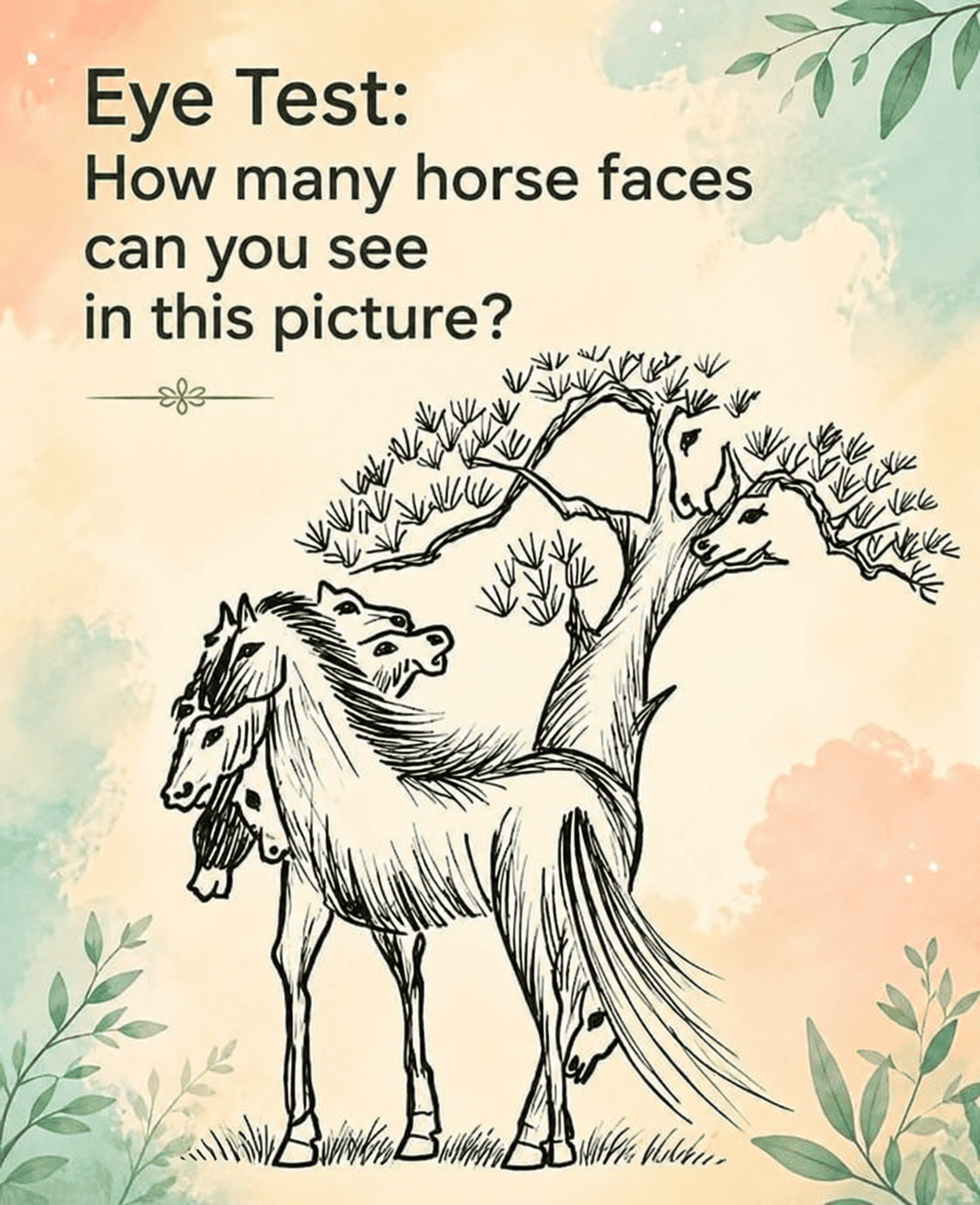
Visual Challenge: How Many Horse Faces Can You Find in This Optical Illusion?
Visual Challenge: How Many Horse Faces Can You Find in This Optical Illusion?
At first glance, this fascinating image might seem like an ordinary illustration of horses. But take a closer look, and you may discover that there is much more hidden within the picture than you initially noticed.
This popular visual challenge asks one simple question: How many horse faces can you find?
It sounds easy, but the answer may not be as obvious as you think.
Some viewers immediately recognize the most prominent horse faces, while others notice additional shapes concealed among overlapping outlines and smaller details.
The puzzle is designed to challenge your observation skills, attention to detail, and ability to recognize familiar patterns.
Before continuing, examine the illustration carefully.
Don’t rush to count. Look at every corner, study the outlines, and see whether you can discover faces that weren’t immediately visible.
Why This Horse Face Puzzle Is So Interesting
Hidden-image challenges have fascinated people for generations.
They appear in puzzle books, newspapers, magazines, and increasingly on social media.
Unlike mathematical problems, these challenges don’t require complicated calculations or specialized knowledge.
Instead, they encourage careful observation.
The horse-face puzzle is particularly interesting because the human brain is naturally skilled at recognizing familiar shapes.
When we see the outline of a horse’s head, we quickly identify the animal based on features such as its ears, muzzle, eyes, and neck.
However, when several similar shapes overlap, recognizing each individual figure becomes more difficult.
The Secret Is in the Details
The most obvious horse face is usually the first one viewers notice.
After recognizing it, the brain may interpret surrounding lines as part of the same figure.
This can make additional faces harder to distinguish.
The challenge is to move beyond that first impression and examine the illustration from different perspectives.
Sometimes, a shape that initially looks like part of a mane or neck may contribute to another recognizable face.
How Optical Illusions Trick the Human Brain
Optical illusions demonstrate that our perception of the world is not always a perfect representation of what is physically present.
Our eyes receive visual information, but the brain must interpret that information to create a meaningful picture.
During this process, it relies on patterns, expectations, contrast, and previous experiences.
These mechanisms help us recognize objects quickly in everyday life.
However, they can also lead to surprising mistakes.
Visual Grouping
One important concept is visual grouping.
The brain naturally organizes nearby lines and shapes into recognizable objects.
When several horse outlines are arranged close together, the brain may combine them into a single larger figure.
As a result, smaller faces may be overlooked.
Figure-Ground Perception
Another important process involves distinguishing objects from their backgrounds.
In some illustrations, empty spaces between larger shapes can form additional recognizable figures.
This technique is common in artistic optical illusions.
A viewer might initially focus on dark lines while ignoring lighter spaces, even though both contribute to the overall image.
How to Find More Horse Faces
If you’re struggling to identify all the horses, don’t worry.
Hidden-object puzzles often become easier when you approach them systematically.
Step 1: Identify the Most Obvious Face
Start by finding the largest or clearest horse face.
Look for recognizable features, including two ears, an eye, and an elongated muzzle.
Once you have identified it, mentally separate that figure from the surrounding details.
Step 2: Examine the Outer Edges
Many visual puzzles conceal smaller objects near the borders of the illustration.
Instead of focusing entirely on the center, examine the top, bottom, left, and right sides.
Follow curved lines carefully.
Step 3: Search for Smaller Shapes
Not every hidden horse face needs to be the same size.
Some may be much smaller than the main figure.
Look for miniature versions of familiar features.
Step 4: Change Your Viewing Distance
Try moving farther from the picture.
Sometimes, larger patterns become easier to recognize when you stop concentrating on individual details.
You can also zoom in to inspect subtle outlines.
Step 5: Count Each Face Carefully
Once you identify a possible horse face, check whether it forms a recognizable head.
Avoid counting the same figure twice.
A systematic approach can reduce confusion and improve your accuracy.