Would You Let Someone With Just One Item Go Ahead of You? The Supermarket Debate Dividing Shoppers
4. What Psychology Says About Waiting in Line
Waiting can feel frustrating because people often perceive their position in a queue as something they’ve earned.
After standing patiently for several minutes, allowing another person ahead may feel like giving up part of that effort.
Psychologists studying waiting experiences have found that perceived fairness plays an important role in how people respond to delays.
A short wait can feel frustrating when it seems unfair.
Meanwhile, a longer wait may feel more acceptable when everyone follows the same rules.
This helps explain why a simple request at the supermarket can produce surprisingly strong reactions.
5. Is Letting Someone Go First Always the Kindest Choice?
Not necessarily.
Imagine you’ve been waiting in line with several people behind you.
You decide to let someone with one item go ahead.
Although your intention is generous, your decision may also delay everyone behind you.
Some shoppers believe this is an important consideration.
If you’re at the front of a busy queue, allowing someone to cut ahead can affect more than just your own waiting time.
The most considerate choice may depend on the circumstances.
6. What If the Person Is Elderly, Pregnant, or Has a Disability?
Certain situations call for additional understanding.
Someone with mobility difficulties, a health condition, or another accessibility need may benefit from assistance.
Offering help can be thoughtful, particularly when the person requests it.
However, it’s important not to make assumptions based solely on appearance.
A polite question or an offer of assistance is generally better than deciding what someone needs without asking.
Some supermarkets also provide priority lanes or accommodations for shoppers with particular needs.
7. How to Handle the Situation Politely
Whether you choose yes or no, there’s no need for confrontation.
If You Want to Let Them Go First
You can simply say:
“Of course, go ahead.”
If You Prefer to Keep Your Place
A calm response works just as well:
“I’m sorry, but I’m in a hurry myself.”
You don’t need to provide a lengthy explanation.
Being respectful doesn’t mean agreeing to every request.
8. Why Supermarkets Have Express Checkout Lanes
Many stores provide express lanes for customers buying relatively few items.
These lanes can reduce waiting times for smaller purchases without requiring shoppers to negotiate their places in line.
Self-checkout stations may offer another option, depending on the store.
However, not every supermarket has these facilities, and busy periods can still create long queues.
That’s why the one-item dilemma continues to happen.
Frequently Asked Questions
Is It Rude to Ask Someone to Let You Go First?
Not necessarily. A polite request is generally more considerate than a demand, and the other person should feel free to decline.
Do People With One Item Deserve Priority?
Not automatically. Unless the store has specific priority rules, the queue generally operates on a first-come, first-served basis.
Is It Wrong to Say No?
No. Declining politely is a reasonable choice, especially when you’re short on time.
Should You Let Someone With a Full Cart Go Ahead?
That’s entirely your decision. Courtesy can take many forms, and the circumstances matter.
What If Someone Cuts in Line Without Asking?
Remain calm and politely point out where the line begins. If the situation escalates, ask a store employee for assistance.
Final Thoughts
The supermarket checkout line might seem like an ordinary place, but it can reveal interesting differences in how people view fairness and courtesy.
Some believe allowing someone with one item to go first is a simple expression of kindness.
Others feel that respecting the order of the line is equally important.
Neither choice automatically defines someone’s character.
What matters most is treating others respectfully, understanding different circumstances, and avoiding unnecessary conflict.
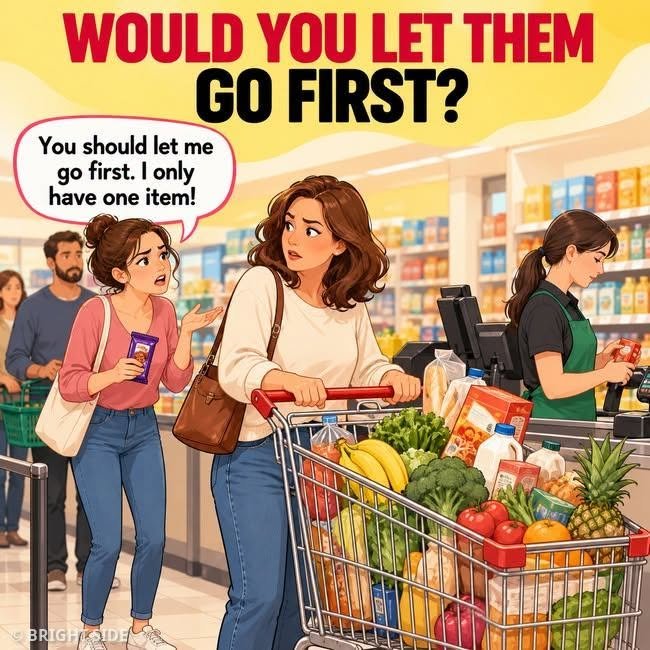
Now imagine you’re standing with a full shopping cart and someone behind you says, “You should let me go first. I only have one item!”
Would you let them go first? YES or NO?