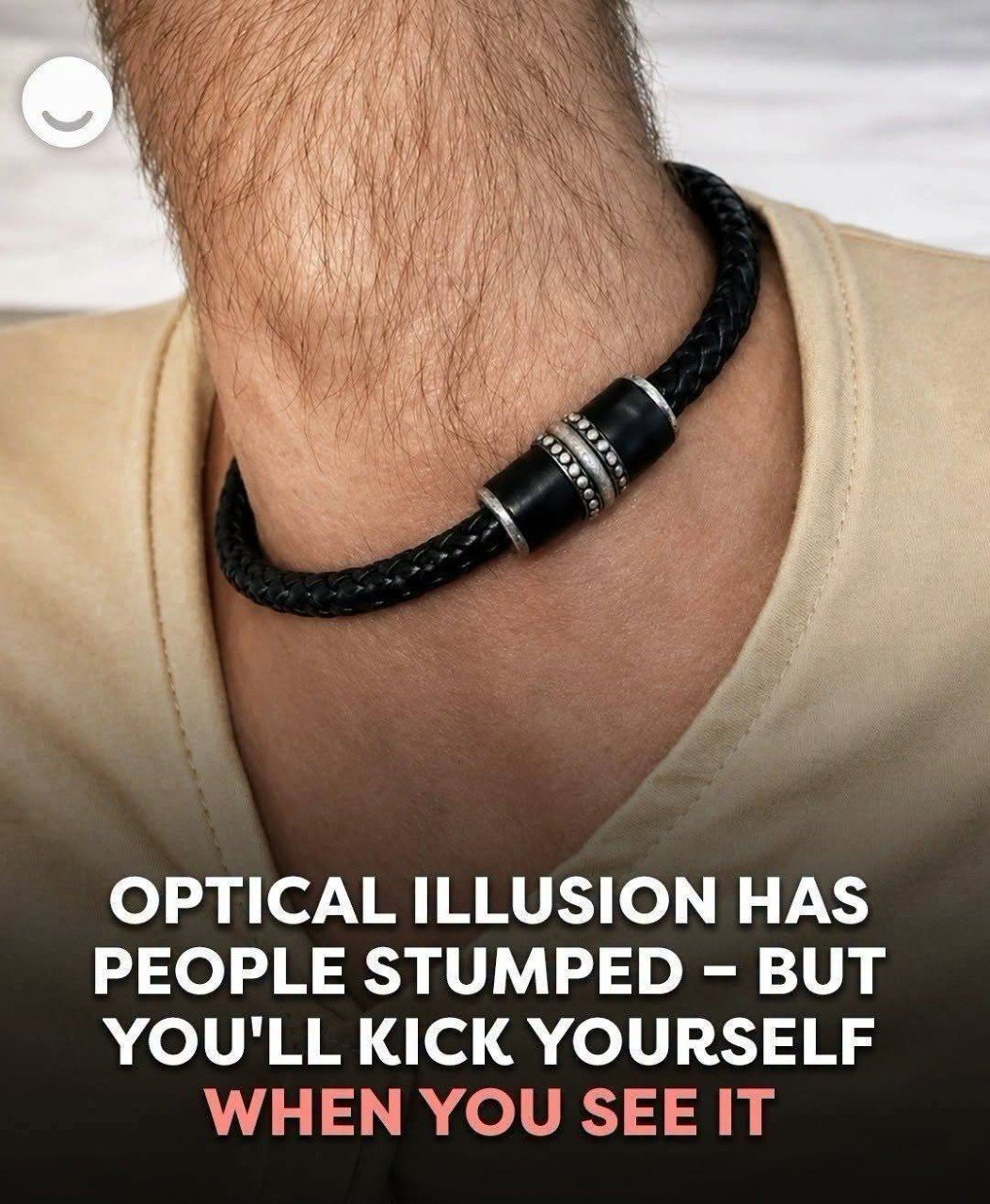
Optical Illusion: Is It a Necklace or a Bracelet?
Optical Illusion: Is It a Necklace or a Bracelet?
At first glance, this looks like a man wearing a thick black leather necklace. Look again: it’s a braided bracelet on a wrist, with the hand tucked against the chest. The V-neck shirt and tight crop make your brain fill in a “neck” that isn’t there. Here’s how to spot the trick and why it fools so many people.
Step 1 — Check the Scale and Surroundings
What to do: Ignore the first impression and look at what surrounds the band.
How to do it: Compare the band’s thickness with the skin around it. A necklace this chunky would look oversized on a neck. On a wrist, the proportions make sense. Then look at the framing: the beige V-neck creates the shape of a collar, which pushes your brain toward “neck.”
Short practical explanation: Optical illusions work by supplying context that points to the wrong answer. Checking scale breaks that spell.
Step 2 — Look for Clues in the Skin and Clasp
What to do: Study the details that don’t fit the neck theory.
How to do it: Notice the skin texture, the direction of the hair, and the creases around the band. Then look at the clasp, which is a barrel-shaped magnetic closure with silver rings. This style is standard on men’s bracelets and rare on necklaces.
Common mistake to avoid: Trusting the first read of the image. Your brain locks onto a familiar shape, and the longer you stare, the more it reinforces the wrong one.
Step 3 — Reframe the Image
What to do: Mentally rotate the picture to see it from a new angle.
How to do it: Imagine the hand and forearm angled up toward the shoulder, with the wrist resting against the collarbone. Once you see the bent wrist, the “neck” turns into the back of the hand.
Short practical explanation: Once you see the second interpretation, it’s hard to unsee it. That’s why these puzzles feel so satisfying.