How Many Dots Do You See? Most People Count 9, But the Real Answer Is Surprisingly Different!
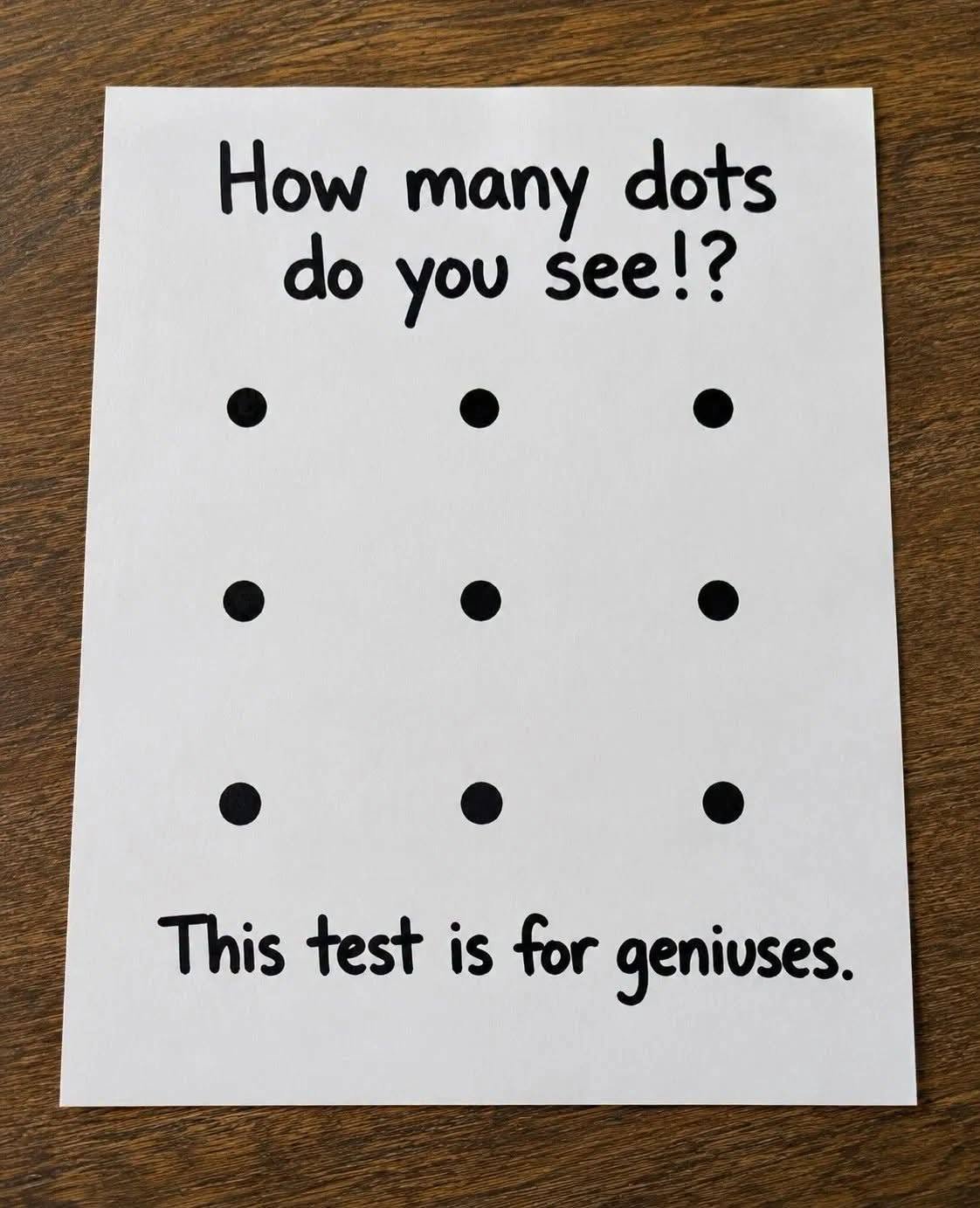
The Real Answer: 13 Dots!
Here’s the complete solution according to the original puzzle.
1. The Nine Large Black Dots
The first nine are the obvious circles arranged in the center.
Running total: 9
2. Two Dots Above the Letters
The puzzle includes the words “This” and “geniuses.”
Each contains a lowercase letter i with a dot above it.
That adds two more dots.
Running total: 11
3. The Period After “Geniuses”
The sentence “This test is for geniuses.” ends with a period.
That punctuation mark counts as another dot.
Running total: 12
4. The Dot Beneath the Question Mark
The question at the top includes punctuation with a small dot beneath the question mark.
That adds one final dot.
Final total: 13 dots!
The Complete Breakdown
| Hidden location | Number of dots |
|---|---|
| Large black circles | 9 |
| Dots above lowercase letters | 2 |
| Period after the sentence | 1 |
| Dot beneath the question mark | 1 |
| Total | 13 |
The answer is surprisingly simple once you understand the trick.
Why This Brain Teaser Is So Clever
The puzzle uses selective attention.
When people are given a task, they naturally focus on information that appears most relevant.
Here, the nine large circles attract attention immediately.
The smaller punctuation marks seem unrelated, so they’re often ignored.
The challenge works because it encourages you to reconsider what actually counts as a dot.
It’s less about difficult mathematics and more about carefully interpreting the question.
Does Solving It Mean You Have a High IQ?
Not necessarily.
Although the image playfully suggests that the challenge is for geniuses, a single visual puzzle isn’t a scientifically validated intelligence test.
Finding all 13 dots may demonstrate careful observation and flexible thinking in that moment.
However, performance can also depend on screen size, image clarity, familiarity with similar puzzles, and attention.
The important thing is enjoying the challenge rather than treating it as a measure of intelligence.
Tips for Solving Similar Puzzles
When you encounter another seemingly simple visual riddle, try these strategies.
- Read the question carefully. Small wording differences may contain important clues.
- Examine the entire image. Don’t focus only on the central objects.
- Check punctuation and letters. Tiny details can be part of the solution.
- Question your first answer. An obvious answer isn’t always the intended one.
- Count systematically. Keep track of every item to avoid overlooking or double-counting details.
These habits can help you approach visual puzzles more confidently.
Frequently Asked Questions
What Is the Correct Answer?
The intended answer is 13 dots.
Why Isn’t 9 Correct?
Nine counts only the large black circles. The puzzle also includes four smaller dots in the text and punctuation.
Where Are the Four Hidden Dots?
Two appear above lowercase letters, one is a sentence-ending period, and one is part of the question mark.
Is This an Optical Illusion?
It’s primarily a visual attention and observation puzzle rather than a traditional optical illusion.
Can Children Solve This Puzzle?
Yes. It’s a fun activity for children and adults who enjoy riddles and hidden details.
Final Thoughts
This simple dot-counting puzzle proves that sometimes the most obvious answer isn’t the complete one.
Most people immediately notice the nine large circles, but the real challenge is recognizing the additional dots hidden in the surrounding text.
Once you include the lettering and punctuation, the total becomes 13 dots.
It’s a clever reminder to pay attention to the entire picture before making a decision.
Now tell us: Did you count 9, 11, 12, or all 13 dots on your first try?