Why Do Padlocks Have Tiny Holes at the Bottom? The Hidden Purpose Explained
Why Do Padlocks Have Tiny Holes at the Bottom? The Hidden Purpose Explained
Padlocks are among the most familiar security devices in everyday life. We use them to protect garden sheds, storage units, bicycles, gates, lockers, and countless other belongings.
Their design seems straightforward: a strong metal body, a curved shackle, and a keyhole or combination mechanism.
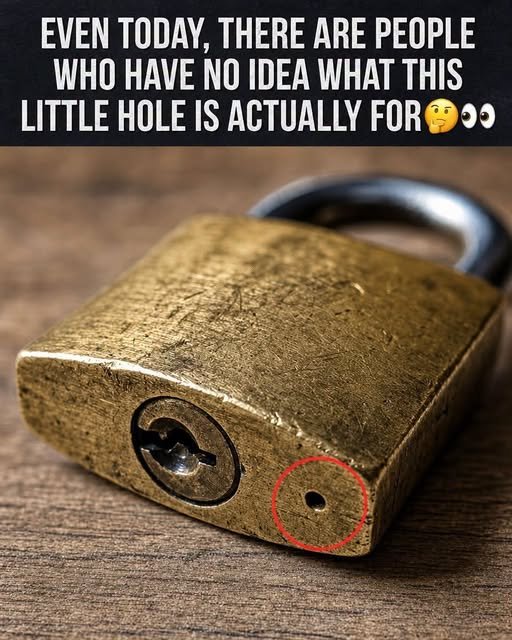
But have you ever turned a padlock upside down and noticed one or two tiny holes in its base?
At first glance, these openings might seem like manufacturing imperfections or unnecessary details. In reality, they can serve important functions that help keep certain padlocks working properly.
Those tiny holes are often designed to help manage moisture, prevent internal damage, and sometimes allow maintenance of the locking mechanism.
Understanding their purpose reveals how thoughtful engineering can make even the simplest household objects more reliable.
The Surprising Reason Some Padlocks Have Small Holes
Many traditional padlocks contain several moving components inside their metal housings.
Depending on the design, these may include springs, pins, locking elements, and other mechanical parts that must move precisely for the lock to function.
When a key is inserted and turned, these components work together to release the shackle.
However, outdoor environments can create problems for the mechanism.
Rainwater, condensation, humidity, and temperature changes may introduce moisture into the lock.
If water remains trapped inside, it can contribute to corrosion and interfere with the movement of internal components.
This is where the tiny openings become useful.
Their Primary Function: Allowing Water to Drain
On many padlock models, small holes near the bottom of the housing serve as drainage openings.
When moisture enters the lock, these holes can provide a pathway for some of that water to escape.
This reduces the chance of water remaining trapped inside the housing.
The principle is simple but practical.
Just as outdoor equipment may include drainage channels to prevent water accumulation, certain padlocks use small openings to help manage moisture.
However, drainage holes do not make a padlock completely waterproof.
Their effectiveness depends on the product’s construction, orientation, and exposure to weather.
Why Moisture Can Damage a Padlock
A padlock may look strong and durable from the outside, but its internal mechanism can be more vulnerable than the thick metal body suggests.
When moisture reaches susceptible metal components, corrosion may gradually develop.
Corrosion can increase friction, weaken certain parts, and prevent the mechanism from operating smoothly.
Over time, users may notice that their keys become harder to insert or turn.
In some cases, the shackle may also become difficult to release.
The Problem With Rust
Rust forms when iron or steel reacts with oxygen and moisture under suitable conditions.
Not every padlock component is made from rust-prone steel, but many locking mechanisms contain metallic parts that can deteriorate through exposure to moisture.
Other metals may also experience different forms of corrosion.
This deterioration does not necessarily happen immediately.
A lock might function normally for months before internal damage becomes noticeable.
That is why preventive maintenance and proper product selection matter.
Another Useful Purpose: Lubrication Access
Drainage is not the only possible purpose of these small openings.
Some padlocks include designated access points for maintenance.
Depending on the manufacturer’s design, an opening may allow a suitable lubricant to reach parts of the internal mechanism.
Lubrication can reduce friction and help moving components operate more smoothly.
However, not every hole on a padlock is intended for lubrication.
Different manufacturers use different designs, and applying substances through an unidentified opening may be ineffective or potentially harmful.
Before lubricating a lock, consult the manufacturer’s recommendations.
Why the Right Lubricant Matters
It might be tempting to use whatever oil is available at home.
However, cooking oils, heavy household oils, and unsuitable sprays can leave residues or attract dust and dirt.
Accumulated debris may eventually interfere with the locking mechanism.
Products specifically recommended for locks are generally a better choice.
Some mechanisms are designed for particular dry lubricants, while others may require specialized formulations.
Following the manufacturer’s instructions helps avoid unnecessary damage.
Which Padlocks Benefit Most From Drainage Holes?
Padlocks used outdoors frequently encounter challenging conditions.
Locks attached to garden gates, sheds, fences, and storage containers may experience repeated exposure to rain and humidity.
Temperature changes can also contribute to condensation.
In colder climates, trapped moisture may freeze and interfere with moving components.
A drainage feature can be helpful in these situations, although the overall weather resistance of the lock remains important.
Indoor padlocks usually experience less direct weather exposure, but they can still encounter moisture in damp basements, garages, and utility areas.