Which Bulb Will Light Up? A Simple Electrical Circuit Puzzle
Which Bulb Will Light Up? A Simple Electrical Circuit Puzzle
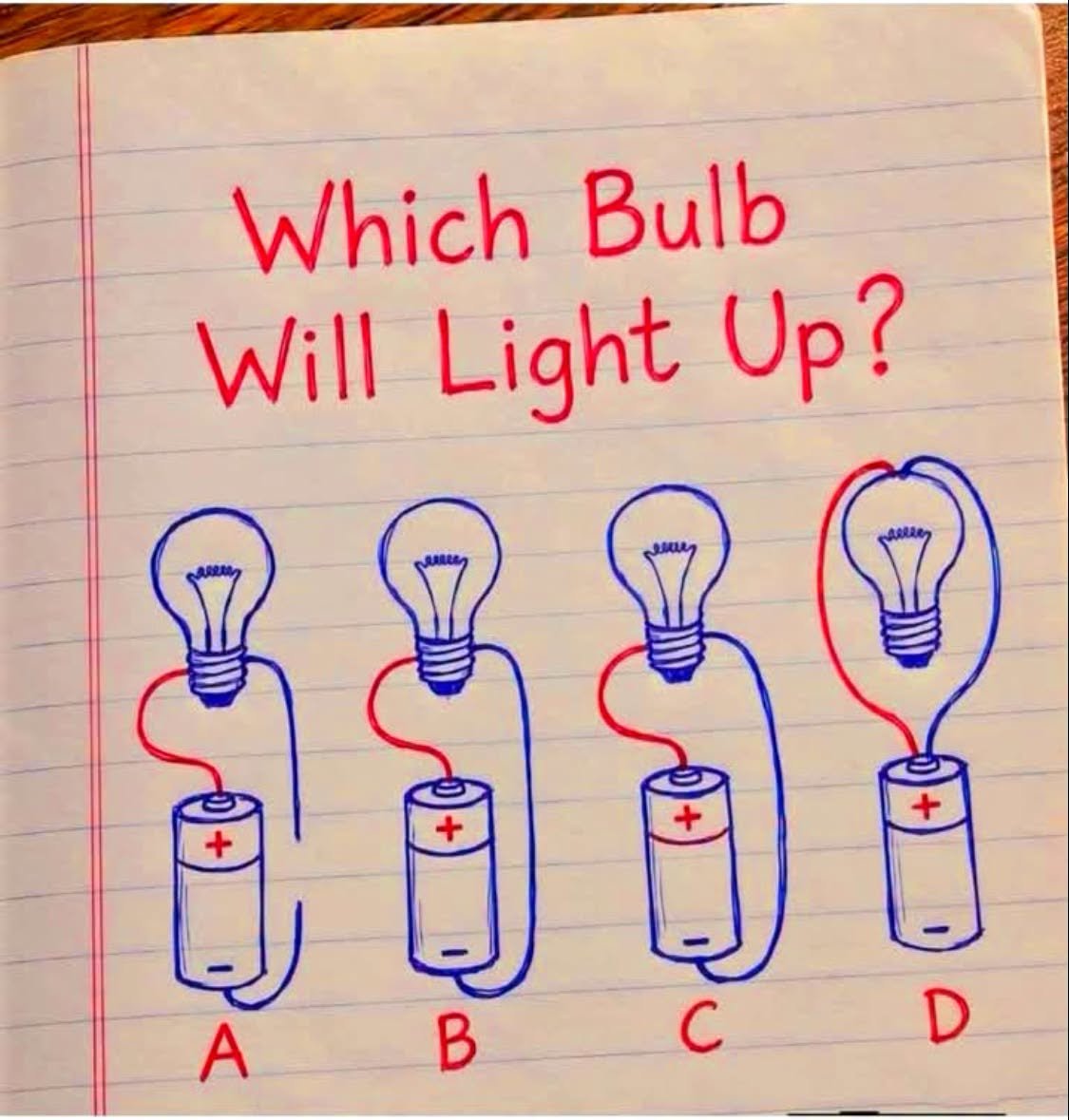
Have you ever wondered what happens when you connect a light bulb to a battery using only two wires? This simple electrical puzzle challenges your knowledge of circuits and electricity. Four different diagrams are shown, but only the correct connection can create a complete electrical path. Let’s examine bulbs A, B, C, and D to understand which one will light up and why.
Step 1 — Understand How a Light Bulb Works
Before choosing the correct answer, it’s important to understand how a traditional screw-type light bulb works.
A standard bulb has two separate electrical contact points:
The bottom contact: The small metal point at the bottom of the bulb.
The metal screw shell: The threaded metal section surrounding the base.
Electricity must enter through one contact and leave through the other to make the filament glow.
If both wires touch the same contact, the bulb will not light up.
Step 2 — Examine the Four Diagrams
Let’s look carefully at each option.
Bulb A: The electrical connection is incomplete. One of the wires does not properly connect to the battery, so electricity cannot flow through a complete circuit.
Bulb B: This diagram shows the correct arrangement. One wire connects the positive terminal to one bulb contact, while the other connects the negative terminal to the second contact. This creates a complete electrical circuit.
Bulb C: The connections do not provide the correct contact arrangement needed to complete the circuit through the bulb’s filament.
Bulb D: Although two wires appear around the bulb, the battery connections do not establish the required complete circuit through its two separate contacts.
Step 3 — Understand Why the Correct Connection Works
Bulb B lights up because electricity has a complete path from the battery’s positive terminal, through the bulb’s filament, and back to the negative terminal.
This is called a closed circuit.
When the circuit is complete, electrical current flows through the filament, causing it to heat up and produce light.