I Poured White Vinegar Into My Toilet Tank and Left It Overnight—Here’s What You Should Know Before Trying It
I Poured White Vinegar Into My Toilet Tank and Left It Overnight—Here’s What You Should Know Before Trying It
Cleaning the toilet is a regular household chore, but there’s one part of the bathroom that many people forget to check: the toilet tank.
Hidden beneath the ceramic lid, the tank contains the water and mechanical components responsible for every flush.
Over time, mineral deposits, sediment, and discoloration can accumulate inside, especially in homes with hard water.
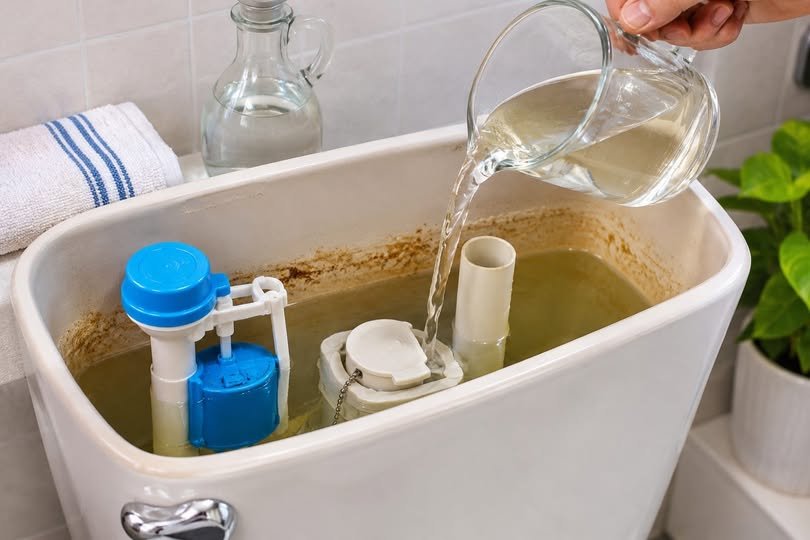
One popular household cleaning trick suggests pouring white vinegar directly into the toilet tank and leaving it overnight.
Supporters claim that this inexpensive ingredient can loosen stubborn deposits and leave the tank looking noticeably cleaner.
But does this trick actually work? And more importantly, is it safe for the plumbing components inside your toilet?
White vinegar can help dissolve certain mineral deposits, but leaving it inside a toilet tank overnight isn’t suitable for every toilet and may damage internal components.
Here’s what homeowners should understand before trying this increasingly popular cleaning method.
Why Does the Inside of a Toilet Tank Get Dirty?
Unlike the toilet bowl, the tank usually remains hidden from view.
Because its interior isn’t regularly inspected, deposits can accumulate unnoticed.
The exact type of buildup depends on local water conditions, plumbing materials, and how frequently the toilet is used.
Hard Water Deposits
Hard water contains dissolved minerals, particularly calcium and magnesium.
As water sits inside plumbing fixtures, mineral deposits can gradually form on surfaces.
These deposits often appear as white, chalky, or crusty buildup.
Rust-Colored Stains
Water containing iron may leave reddish-brown discoloration.
In some cases, corrosion from metal plumbing components can contribute to staining.
Sediment
Small particles carried through the water supply can settle at the bottom of the tank.
Over time, these particles may create a layer of debris.
Biological Buildup
Depending on moisture conditions and water quality, some tanks may develop slimy deposits or other biological growth.
Not every dark stain is mold, and identifying the cause can help determine the appropriate cleaning method.
Why Do People Use White Vinegar for Cleaning?
White vinegar is a common household ingredient that contains acetic acid.
Ordinary distilled white vinegar typically has an acidity of approximately 5%.
This makes it useful for loosening certain mineral deposits.
Calcium carbonate, one of the common components of limescale, reacts with acids.
As a result, vinegar can help soften some hard-water buildup, making it easier to remove.
What Vinegar Can Do
Under suitable conditions, white vinegar may help:
- Loosen certain calcium-based mineral deposits.
- Reduce some chalky residue.
- Make light surface buildup easier to scrub.
- Remove some mineral-related discoloration.
However, vinegar does not remove every type of stain.
Iron deposits, damaged surfaces, and longstanding buildup may require different approaches.
Vinegar is also not a substitute for an EPA-registered disinfectant when actual disinfection is required.
What Happens When Vinegar Sits in a Toilet Tank Overnight?
The idea behind an overnight soak is simple.
By increasing contact time, the acid has more opportunity to react with mineral deposits.
Some deposits may gradually soften or partially dissolve.
This can make them easier to remove afterward.
However, the same prolonged contact also exposes the tank’s internal components to acidic water.
The Hidden Problem
Most toilet tanks contain more than ceramic surfaces.
Inside, you’ll find components such as:
- A rubber flapper or other flush-valve seal.
- A fill valve.
- Plastic and rubber gaskets.
- Metal fasteners.
- Other mechanical fittings.
Depending on their materials and condition, these components may be affected by inappropriate cleaning chemicals.
Some toilet manufacturers specifically warn against using acidic cleaners or descaling products inside their tanks.
Therefore, an overnight vinegar soak should not be treated as a universally safe cleaning technique.