“I Met a Man on London Bridge”: Can You Solve This Clever Riddle?
“I Met a Man on London Bridge”: Can You Solve This Clever Riddle?
Some riddles seem so simple that we immediately assume the answer must be obvious. Yet the most entertaining brain teasers often hide their solutions in ordinary words, encouraging us to think more carefully about what we read and hear.
One particularly popular example is the “I Met a Man on London Bridge” riddle.
It describes a brief encounter with a stranger and asks you to discover his name.
There are no complicated calculations, mysterious objects, or lengthy instructions. Everything you need is contained in just a few words.
But there’s a catch: the answer depends on how you interpret the sentence.
Before continuing, try solving the puzzle yourself.
The Riddle: Can You Figure Out the Man’s Name?
Read the following lines carefully:
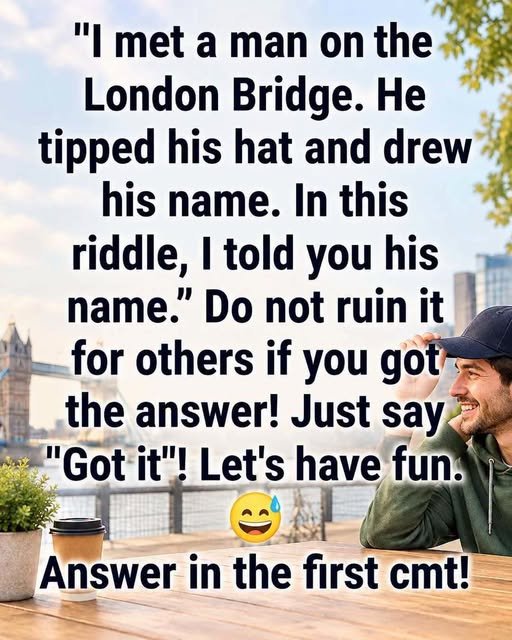
I met a man on London Bridge.
He tipped his hat and drew his name.
In this riddle, I told you his name.
What is the man’s name?
At first glance, the question seems straightforward.
The narrator meets a stranger on London Bridge. The man tips his hat and performs an action described as drawing his name.
But where exactly is his name mentioned?
You might read the lines several times without noticing anything unusual.
Some people begin searching for hidden letters. Others wonder whether the location provides a clue.
The solution, however, requires a different approach.
Pay particular attention to the phrase “and drew.”
It contains the key to the entire puzzle.
Why This Simple Riddle Confuses So Many People
The challenge works because most readers initially focus on the meaning of the story.
We imagine a man standing on a bridge, greeting someone politely, and perhaps writing or drawing something.
Our minds naturally concentrate on the scene.
London Bridge sounds like an important location, so we may assume its history or name contains a hidden clue.
The gesture of tipping a hat also attracts attention because it seems deliberately included.
But neither detail is essential to the solution.
The riddle relies on a technique known as a phonetic pun.
A phonetic pun uses words or expressions that sound similar to other words, even though their spelling and meaning differ.
When spoken aloud, the phrase containing the man’s name becomes much easier to recognize.
The Clue Hidden in an Ordinary Sentence
Consider this line again:
“He tipped his hat and drew his name.”
The words “and drew” are the most important part.
When pronounced together, they sound similar to a familiar English first name.
The trick is that your brain usually interprets the words according to their grammatical roles.
You understand “and” as a conjunction connecting actions.
You understand “drew” as the past tense of “draw.”
Because the sentence appears grammatically ordinary, you may never consider combining their sounds.
That is exactly what makes the puzzle effective.
It encourages you to interpret written language literally while hiding the answer in pronunciation.
What Makes Wordplay Riddles So Entertaining?
Wordplay riddles differ from traditional logic puzzles.
A mathematical problem usually requires calculations or a sequence of deductions.
A visual puzzle asks you to identify patterns or objects.
A wordplay riddle challenges your understanding of language.
The same expression may have different interpretations depending on how it is pronounced, divided, or emphasized.
This makes language-based puzzles especially entertaining in group settings.
A person listening to the riddle may recognize the sound immediately, while someone reading the same words might struggle.
Neither approach necessarily reflects greater intelligence.
The puzzle simply takes advantage of how people process written and spoken language differently.